


Dedicated Firewall or Layer 3 Switches: Advantages and Disadvantages
One of the most important design decisions in a segmented corporate network is determining where inter-VLAN routing should take place. Traditionally, there are two main approaches: using a firewall as the gateway for all VLANs or delegating routing responsibilities to Layer 3 switches. While both designs are perfectly valid, each serves different priorities and can significantly impact network performance, security, and operational management.
In this article, we’ll examine the advantages and disadvantages of each approach and explain why the best choice depends more on an organization’s goals than on any supposed universal best practice.
The Scenario
Imagine a corporate network segmented into multiple VLANs:
- Administration
- Servers
- User Workstations
- Corporate Wi-Fi
- IoT Devices
- Security Cameras
- Development
- Guest Networks
All devices connect to managed switches, and traffic between VLANs must be routed before reaching its destination.
The question is simple:
Should inter-VLAN routing be performed by the firewall or by Layer 3 switches?
Option 1: Routing Through Layer 3 Switches
In this design, the Layer 3 switch acts as the default gateway for all VLANs.
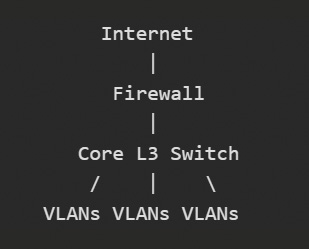
The switch creates virtual interfaces (SVIs) for each VLAN and performs routing internally using dedicated hardware.
Advantages
Maximum Performance
Modern Layer 3 switches use specialized ASICs capable of forwarding traffic at extremely high speeds with minimal latency.
Traffic between VLANs never leaves the switch, eliminating an extra hop through the firewall.
Reduced Firewall Load
The firewall no longer processes large volumes of internal traffic.
This allows its resources to be focused on:
- Internet access
- VPN services
- IDS/IPS inspection
- NAT
- Application filtering
Better Scalability
As organizations grow, internal traffic often increases significantly.
Layer 3 switches usually scale better in environments with:
- Virtualization clusters
- Storage systems
- Backup infrastructure
- Inter-site replication
Lower Latency
Inter-VLAN communications require less processing and fewer network hops.
Disadvantages
Reduced Visibility
Inter-VLAN traffic no longer passes through the firewall.
This results in:
- Less centralized logging.
- Reduced auditing capabilities.
- Limited visibility into internal communications.
More Complex Access Control
Security policies must be implemented through switch ACLs.
For example, a simple firewall rule such as:
Allow HTTPS from Users to Servers
may require multiple ACL entries applied across several VLAN interfaces.
ACL Management Can Become Difficult
Although very powerful, ACLs are often:
- Harder to maintain.
- More prone to configuration errors.
- Less intuitive during audits.
- Stateless by nature.
As the number of network segments grows, administration can quickly become more complicated.
Option 2: Routing Through a Dedicated Firewall
In this design, all VLANs use the firewall as their default gateway.
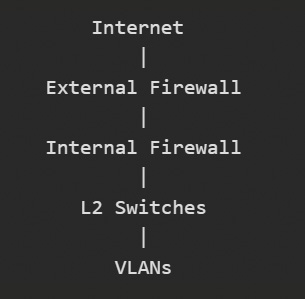
Every communication between VLANs traverses the firewall before reaching its destination.
Advantages
Complete Traffic Control
All inter-VLAN traffic is visible and manageable from a single point.
This makes it easy to enforce granular security policies such as:
- Users → Servers
- IoT → Internet
- Guests → Internet Only
- Development → Production
Every flow can be monitored, restricted, or blocked as needed.
Simplified Administration
Most IT teams find firewall policies easier to manage than extensive ACL configurations distributed across multiple switches.
Management is typically more centralized and intuitive.
Auditing and Traceability
When an incident occurs, administrators can quickly determine:
- Who accessed what.
- When the access occurred.
- Where the connection originated.
All relevant information is concentrated in a single platform.
IDS/IPS Integration
Solutions such as OPNsense, pfSense, FortiGate, Palo Alto, and Check Point can inspect internal traffic using IDS/IPS engines.
This enables detection of:
- Lateral movement
- Internal scanning
- Malware activity
- Suspicious behavior
Disadvantages
Increased Firewall Load
The more internal traffic flows through the firewall, the more processing power it requires.
In environments with:
- Large virtualization platforms
- Storage traffic
- Intensive backup operations
- Continuous data replication
the firewall may eventually become a bottleneck.
Additional Latency
Every inter-VLAN communication requires firewall processing.
While this is generally imperceptible to end users in modern enterprise environments, it remains an additional step.
Dependence on the Firewall
A firewall failure can impact:
- Internet connectivity
- Internal communications
- Inter-segment access
For this reason, high availability is strongly recommended whenever the firewall participates in internal routing.
Which Option Is Better?
The correct answer is the same one that appears in many architecture discussions: it depends.
If maximum performance is the primary objective, Layer 3 switches are usually the preferred solution.
If security, visibility, and centralized policy control are the primary objectives, a dedicated firewall offers advantages that are difficult to match.
The Hybrid Approach
Many mature organizations eventually adopt a hybrid model.
For example:
Firewall
- User VLAN
- Wi-Fi VLAN
- IoT VLAN
L3 Switch
- Server VLAN
- Backup VLAN
- Storage VLAN
High-performance segments use the switch for routing, while security-sensitive segments continue to traverse the firewall.
This design aims to combine the strengths of both approaches.
Conclusion
There is a common perception that Layer 3 switching is always the technically superior solution. However, that view often overlooks critical factors such as visibility, segmentation, and policy management.
In many medium-sized corporate environments, especially those with a strong security and segmentation strategy, keeping the firewall as the central routing point can be a completely valid and sometimes preferable decision.
Ultimately, the goal of an enterprise network is not merely to move packets as fast as possible, but to do so securely, predictably, and in alignment with business requirements.
When the entire architecture is considered rather than pure forwarding performance, dedicated firewall-based inter-VLAN routing remains a highly relevant and widely adopted design in modern corporate networks.


Leave a Reply